Back to Amphibians
Amphibian Fact Sheet
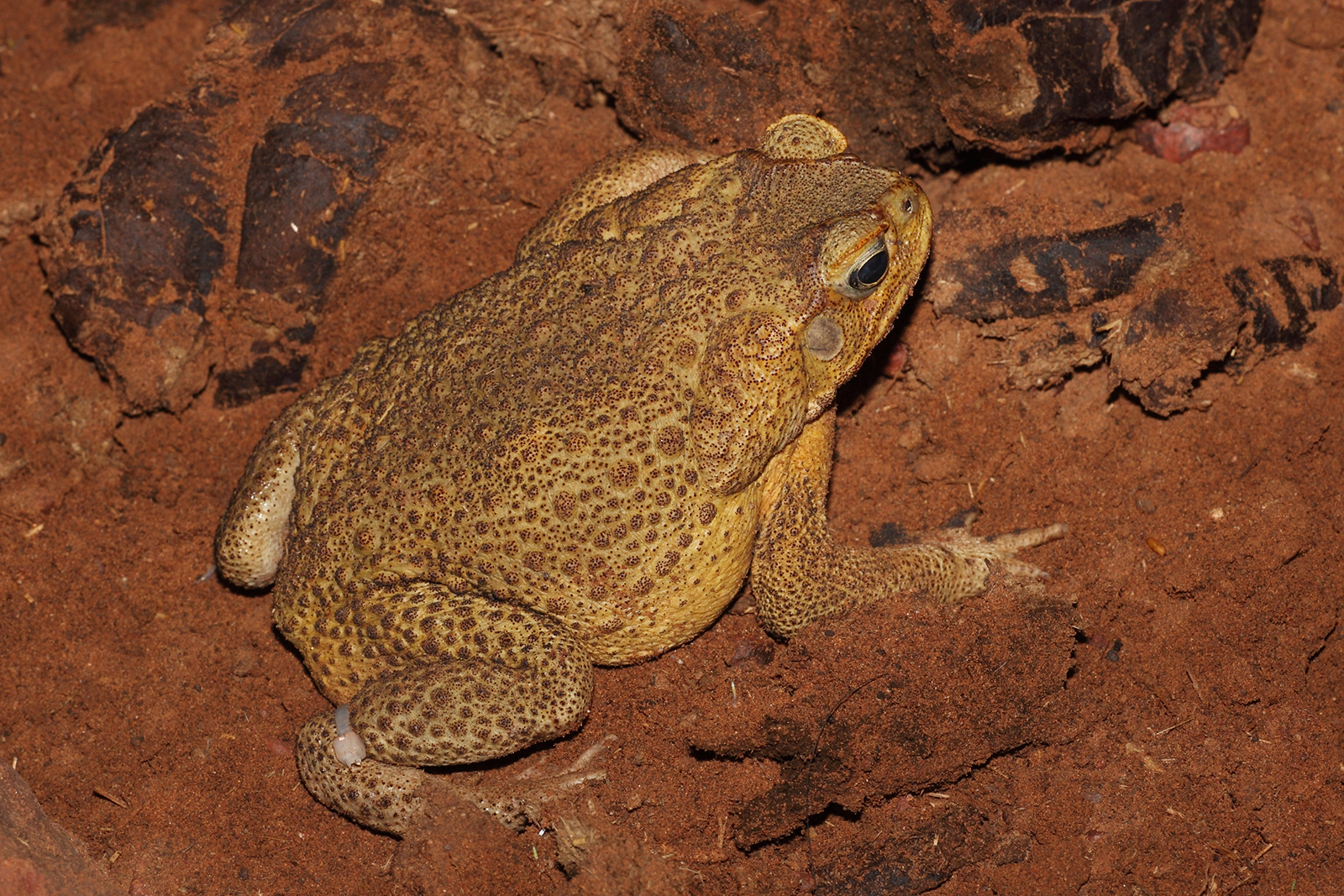
Cane Toad
LC· Least ConcernRhinella marina
Warm, humid lowlands — grassland, forest edges, farmland and suburbs.
Fact Sheet
About this animal
Key facts about the cane toad.
Common Name
Cane Toad
Scientific Name
Rhinella marina
Classification
Amphibia • Anura • Bufonidae
Distribution
Native to Central and South America. Introduced to Australia, the Caribbean, the Philippines and Pacific islands.
Habitat
Warm, humid lowlands — grassland, forest edges, farmland and suburbs.
Range map · red pin marks a typical locationView larger map
Lifecycle
Females lay 8,000–30,000 eggs in long jelly-like strings in still water; tadpoles turn into toadlets in 4–10 weeks.
Diet
Almost anything it can swallow — insects, small reptiles, mammals, other frogs and even pet food.
Size
10–15 cm (4–6 in); large females can reach 25 cm.
Lifespan
5–10 years in the wild, up to 15+ in human care.
Conservation Status
LC· Least Concern
Least Concern (invasive in many introduced ranges).Behaviour
Nocturnal and terrestrial. Confident and slow — walks rather than hops.
Adaptations
Large parotoid glands behind the eyes make a strong toxin that can kill predators. Very high tolerance for dry conditions for a toad.
Predators
In its native range: caimans, snakes and some birds that can handle the toxin. In Australia, most native predators are poisoned by it.
Interesting Facts
- Introduced to Australia in 1935 to eat sugar-cane beetles — it didn't work, and the toads spread instead.
- The world's largest 'true toad'.
Photo: Wikimedia Commons (CC BY-SA) · Habitat: Tropical Australian wetland — Wikimedia Commons